Case study 02

Hifive
Pivot to product-market fit
I joined CoSell, a co-selling tool for sales teams, as lead product designer. Interviews with more than 50 founders showed the connector, not the data, knows which intros will land. That turned it into Hifive: a LinkedIn extension founders actually used, and the strategy behind its acquisition.
I owned research, strategy, product and brand, working with two co-founder CEOs, a PM, three engineers and a junior designer I mentored.
In the first three months after launch, successful warm intros rose 42% for early users, and the paid network grew to 50+ super connectors.
- Role
- Lead product designer
- Team
- 2 CEOs, 1 PM, 3 engineers, 1 junior designer
- Timeline
- 2022 – 2024
- Outcome
- plus 42 percent
Context
Warm introductions close deals, but the product built to scale them was making intros harder, not easier.
When I joined as lead product designer in 2022, Hifive was still called CoSell. It was a co-selling platform for sales teams, where partner companies help each other reach customers: companies connected their CRMs, the platform found overlaps between contact lists, and reps could ask colleagues and partners for warm introductions to high-value leads. The bet was that sales teams would pay for seats because warm intros turn into closed deals.
I’d worked with one of the founders years earlier on the proof of concept he used to raise the company’s first round. When I came back, the team knew there was something real in the warm-intro space, but there was no product strategy behind it. Each MVP had been a “kitchen sink” of features aimed at problems nobody had confirmed.
Problem
Lots of requests, very few intros: only about 6% of requests ever became an introduction.
The founders came from sales at Atlassian and LinkedIn, and they were great at getting teams to trial the product. Hardly anyone stayed. A handful of reps logged in, and customers weren’t renewing.
The product depended on everything going right at once. Contact data had to come from several CRMs and stay clean. Both sides of a relationship had to adopt the platform and agree to share their contacts. Invitations went out through an email relay that recipients didn’t trust. Even when it worked, members flooded connectors with requests, and the actual work of an introduction (finding the right person, giving the connector context, writing the outreach) happened over email, outside the product.
While we worked out the real problem, we explored a few directions, including a social feed for asks and offers and a shared dashboard built on everyone’s CRM data. Both depended on people joining and sharing their networks first.
Insight
The connector, not the data, knows which introductions will land.
I started with the existing customers. Then I went further than the product and looked at the spreadsheets, Slack channels and task boards where people actually managed intros. What they wanted was the needle in the haystack, and the data couldn’t reliably find it.
We tested the obvious next step: let AI surface potential leads as matches, have requesters rate them, then ask the connectors who owned those relationships to rate them too. The connectors consistently knew better. They knew which relationships were genuinely warm, who in a company was the right person, and when a request would land. However hard we tried to infer relationships from data, we had to respect the connector rather than route around them.
Across interviews with more than 50 founders, and the connectors they relied on, the same pattern kept coming up:
- Connectors want to help. Making intros is pay-it-forward. Someone did it for them once.
- They have limits. There’s only so much they’ll ask of their network, and only so often.
- There’s a natural sequence. The requester explains what they want. The connector checks with the contact first. Only if the contact agrees does the connector loop the requester in and step back.
Our earlier product had tried to turn that conversation into rigid “request, approval, pending” states. The tracking was unreliable, and it replaced a human exchange with a workflow nobody wanted.
The research also changed who we were building for. Sales teams already had tools and processes for this, and their leads were already responsible for finding intros. Founders were different: they need many kinds of introductions, and they have plenty of people willing to make them.
Decisions
Meet people where the work already happens, put the effort on the person who benefits most, and let the connector curate.
The data made the case: trials without renewals, and a 6% intro rate. I used it, along with the research, to get the team to agree on the problem before anyone picked a solution. One co-founder was on board immediately. The other was convinced he already knew the answer but couldn’t say what problem it solved. Working from evidence gave the thesis wider support across the team, and we moved quickly.
Decision
Where the product lives
Considered
Standalone platform
Full control, but users have to import data, rebuild habits and bring both sides of every relationship onto a new tool.
Chosen
Chrome extension on LinkedIn
Networking already happens on LinkedIn and outreach happens over email. Add intros right there.
- Cost
- We depended on LinkedIn's interface: every UI change or A/B test broke something.
- Pushback
- One co-founder was set on a different solution. I used the renewal data and the research to align the team on the problem first.
Founders keep using LinkedIn as normal, and the extension opens beside it. The main flow runs through LinkedIn search: pick a connector from your own connections, then browse theirs, filtered by title, company, industry or location, where every result gets a “Request intro” button. On a profile, the same button appears, and on someone outside your network a “Get intro” button shows which of your connections know them. The tradeoff: we depended on someone else’s interface.
A founder requests a warm intro without leaving LinkedIn. From the Hifive panel on the LinkedIn home page they choose Request an intro, then view their 1st-degree connections; every search result shows a Request intro button. They click it on Frank, who fills the Who will make the intro card, then choose See who Frank can introduce you to. Frank's connections now show Request intro from Frank; they click it on Kathleen, who fills the Who do you want to meet card. They continue to a drafted request built from data pills, Kathleen's name, Frank's name and her LinkedIn URL, which loads in as they watch. They send it and see Request sent.
Decision
Who does the work
Considered
Connector joins the platform
Accurate data, but asks a favor-giver to sign up for an unknown tool and share their whole network.
Chosen
Requester does the work
The person who gains the most from the intro does the setup. The connector never needs an account.
- Cost
- More setup for the requester, so AI had to make writing the request fast.
You can’t assume one person signing up brings their connectors along. The requester writes the request in the extension, and AI helps: it identifies their goal, gathers context on the person they want to meet, finds the most likely contact details and drafts outreach that fits the relationship. The connector gets a simple review page with no login. They confirm the contact details are right, adjust the message and send it from Gmail or their own mail client. We still knew whether each request was approved, sent or declined.
Building and reusing a template. In the web app the founder opens Templates and creates a new one, which starts prefilled with variable pills for the connector and the prospect. They name it Seeking investors, add a line, open Personalize, insert a Personal: Company variable and give it the fallback our company. Then, in the extension, they choose Select template, pick Seeking investors, and the request fills in with Frank's and Kathleen's details.
Decision
How the right person gets picked
Considered
Requester picks the person
Requesters went digging through connectors' contacts, which are often stale. We all accept LinkedIn requests from people we barely know.
Considered
Requester sends a shortlist
Better, but connectors kept replying with their own list instead.
Chosen
Requester defines the need
Industry, role, company size and stage become filters. The connector picks from their own network.
This took three rounds, and every one moved more judgment to the connector. In the end the requester describes who they need, and the connector sees their own contacts filtered to that description and builds a quick shortlist. Nobody chases ghosts. We also cut a feature: one-click “approve” buttons inside the request emails. They were meant to save time, but people read them as impersonal and many thought they were spam or phishing.
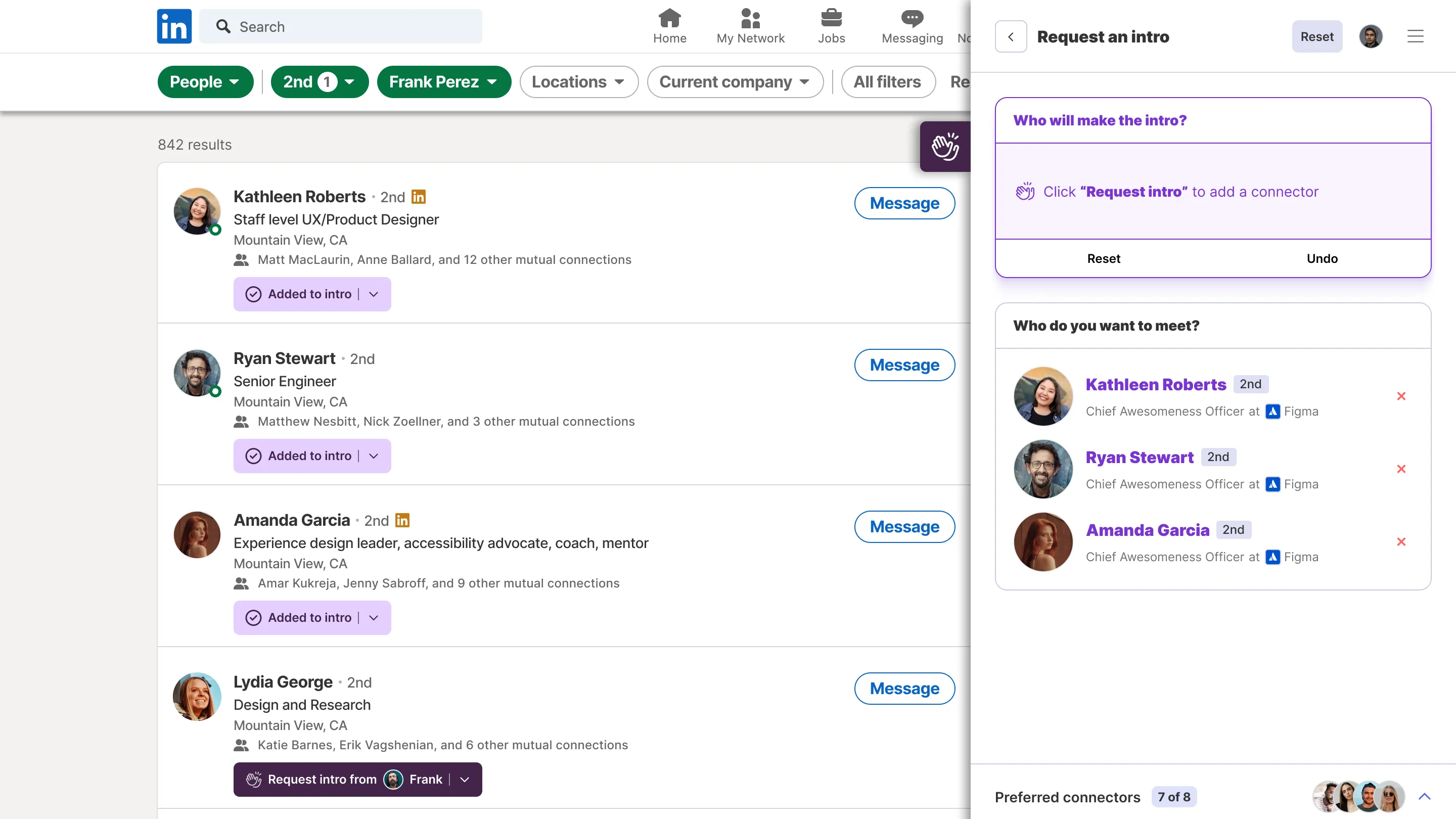
The shortlist version of a request. In Frank's connections, the founder clicks Request intro from Frank on Kathleen, then Ryan, then Amanda; each is added to the Who do you want to meet card. They continue to one request to Frank that lists all three people, send it, and see Request sent listing Kathleen, Ryan and Amanda.
Alliances
The best intros came from a few super connectors, so we gave each founder and connector a shared place to work.
The requester flows doubled as research. They showed us a small group of “super connectors”: people who make big introductions as a side business and take a cut when deals close. Once we understood their process, motivation and capacity, it was clear they were the key to successful intros, so we built for them.
We called the result an alliance: a founder and a super connector sharing targets, offers and progress in one place. With an engaged network and a track record of intros, attracting founders became the easy part. The paid network grew past 50 super connectors, and their introductions delivered real outcomes, closed deals and founders connected with investors, not just conversations. The alliance model I drove became the foundation of the company’s acquisition.
Outcome
Fewer requests, better ones: the new model made 42% more successful introductions than CoSell, by matching to real relationships instead of chasing volume.
CoSell had chased volume. Members blasted out requests, many of them bad fits a connector would never make, and only about 6% ever became an introduction. The new model inverted that: by building around the connector and the relationships they actually had, we cut the dead-end requests and raised the share that landed. Fewer requests went out, and the ones that did were introductions connectors were glad to make.
Total requests went down, and the share that turned into real introductions went up.
In the first three months after launch, that produced 42% more successful introductions than CoSell had, counting a successful introduction as a request a connector actually turned into an intro, not a dead end. The product had found product-market fit with founders.
plus 42 percentMore successful introductions than CoSellFirst three months after launch, from far fewer total requests
50+Super connectors in the paid networkTheir intros delivered closed deals and investor connections
I also led the rebrand from CoSell to Hifive. The old name suggested selling and the colors put people off, which mattered most at the moment of trust: the branded email and landing page a first-time connector sees. The new brand came across as far more trustworthy. Alongside it I built a component library shared with our front-end-focused junior designer, so we could prototype and review quickly from the same patterns.
Hifive was acquired by HeyLois, for the platform and the super-connector network it had attracted. That network was the asset, and it was the proof of the original bet: that the way to make warm introductions scale was to build around the connector, not the data.
Reflection
Define the problem, not the solution, and design around the person who makes the outcome happen.